Branded Short Links ROI: How to Measure the Value of Branded URLs
Learn how to measure the ROI of branded short links: formulas for incremental contribution profit, A/B testing protocols, GA4 attribution, and domain cost analysis.
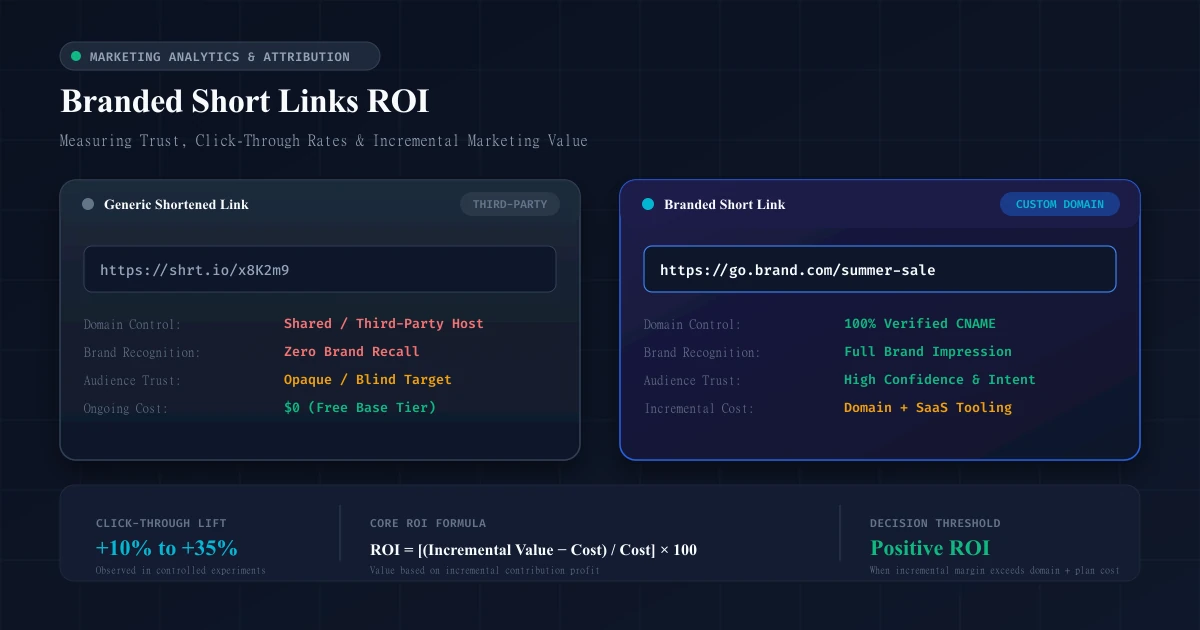
Branded Short Links ROI: How to Measure the Value of Branded URLs
In modern growth marketing, every inbound touchpoint is under financial scrutiny. Teams allocate substantial budgets to paid search campaigns, content production, email automation platforms, and influencer partnerships. Yet when distributing campaign URLs across external channels, many organizations still rely on generic, third-party shortener domains or raw, unwieldy destination addresses.
Adopting a branded short domain—such as links.yourbrand.com or go.company.co—requires real organizational resources: purchasing a dedicated domain name, completing DNS CNAME verification, maintaining subscription tiers on a SaaS link management platform, and establishing internal campaign naming workflows.
Is configuring a branded custom domain worth the investment? How do you isolate the financial return of a custom short link from overall campaign performance? And how can growth teams measure return on investment (ROI) using rigorous, verifiable data rather than marketing folklore?
This guide provides an evidence-based framework for calculating the ROI of branded short links. We examine the psychological and mechanical differences between generic and branded URLs, provide an exact mathematical ROI formula based on incremental contribution profit, walk through Google Analytics 4 (GA4) attribution setup, and outline how to run valid split tests without falling victim to common measurement traps.
What Are Branded Short Links?
A branded short link (also known as a custom short URL or vanity URL) is a concise web address that incorporates an organization's proprietary domain name or dedicated subdomain alongside a meaningful back-half path.
Instead of routing traffic through a shared public shortener domain (shrt.io/x9K2p), a branded short link maintains organizational brand consistency directly within the URL string (links.yourbrand.com/annual-report or go.brand.co/demo).
Behind the scenes, branded short links function identically to enterprise URL shorteners:
- The visitor clicks or types the branded URL in their browser or mobile app.
- The request resolves via DNS to the link management platform's edge servers.
- The platform executes an in-memory cache lookup (typically using Redis) to match the host header and path key against its database.
- The server dispatches an HTTP redirect (most commonly an HTTP 302 Found or HTTP 307 Temporary Redirect) with a
Locationheader pointing to the final destination URL.
To understand the underlying server mechanics, token collision handling, and caching tiers powering these redirects, explore our comprehensive technical guide on how URL shorteners work.
Branded vs Generic Short Links: Key Differences
When evaluating whether to deploy custom short domains across your tech stack, it is essential to understand how branded links differ from generic shortened links. Both approaches allow marketers to condense long URLs and inspect click metrics, but their operational control, security boundaries, and audience perception diverge significantly.
| Feature / Dimension | Generic Shortened URLs | Branded Shortened URLs |
|---|---|---|
| Brand Visibility | None. Displays third-party shortener branding (e.g., bit.ly, tinyurl.com). | Complete. Highlights your brand name or product moniker on every shared link. |
| Custom Domain Control | Zero. You share the root domain with millions of unknown third parties. | 100%. Owned by your organization via DNS CNAME and TXT verification records. |
| Audience Memorability | Low. Random alphanumeric character strings (/3xK9q1) are unpronounceable. | High. Custom vanity slugs (/spring-sale) are memorable and readable on audio/video. |
| Audience Trust & Safety | Variable. Blind short links trigger anti-phishing hesitation and corporate security filters. | High. Clear domain ownership reassures enterprise firewalls and discerning users. |
| Measurement Capabilities | Basic click telemetry provided by the platform (clicks, rough geolocation). | Advanced edge telemetry, full UTM parameter pass-through, and custom API tracking. |
| Cost Considerations | $0 to minimal (often supported on free tiers of consumer shorteners). | Incremental cost: Annual domain registration fee ($10–$50/yr) + SaaS subscription. |
| Typical Use Cases | Personal social sharing, one-off community links, internal draft reviews. | Omnichannel marketing, paid advertising, SMS messaging, print collateral, partner affiliate links. |
Important Analytical Distinction: Generic shorteners are not incapable of tracking clicks. Rather, generic links force organizations to surrender domain equity, brand exposure, and root routing control to an external entity.
Why Businesses Use Branded Short URLs
Marketing leaders, brand managers, and growth engineers deploy branded short links to solve three concrete commercial problems:
1. Eliminating "Blind Click" Resistance
In an era saturated with phishing scams, credential harvesting, and malicious redirects, internet users and enterprise IT security scanners are rightfully skeptical of anonymous shortened URLs. A generic short link provides zero context regarding where the user will land upon clicking.
By displaying your organization's verified domain name (links.yourbrand.com), you provide immediate provenance. The visitor recognizes the brand before initiating the network handshake, lowering friction and increasing user willingness to click across high-stakes channels like SMS and cold email.
2. Maximizing Media Real Estate and Cross-Channel Recall
When distributing campaigns across character-constrained channels—such as SMS text messages, Twitter/X posts, podcast sponsorships, outdoor billboards, and conference presentation slides—every character matters.
A concise branded link like brand.shop/vip communicates your brand name and your value proposition in under 18 characters. If you are pairing short links with physical signage or packaging, explore our QR code print size and resolution guide to ensure printed symbols scan reliably alongside human-readable vanity text.
3. Protecting Domain Reputation and Link Longevity
When you rely on a shared public shortener, your brand's deliverability is tied to the actions of every other user on that domain. If bad actors distribute spam or malware through the shared shortener, major anti-abuse filters (such as Spamhaus, Google Safe Browsing, or carrier SMS firewalls) may blacklist the entire root domain.
Using your own custom domain isolates your links from third-party bad behavior. Furthermore, because you own the underlying domain registration, you maintain perpetual ownership of your link assets. For step-by-step registrar walkthroughs, consult our guide on how to set up a custom short domain.
What Does ROI Mean for Branded Links?
Return on Investment (ROI) is one of the most frequently cited—and frequently misunderstood—metrics in digital marketing. In casual conversation, marketers often conflate raw click volume, top-line impressions, or gross revenue with true financial return.
To measure the ROI of branded short links accurately, we must adhere to rigorous financial definitions:
$$\text{ROI} = \frac{\text{Net Financial Return}}{\text{Cost of Investment}} \times 100$$
When applied specifically to branded short links, this calculation answers a precise question:
Did the incremental contribution profit generated by switching from generic links to branded links exceed the incremental costs of acquiring, configuring, and maintaining the custom domain infrastructure?
Notice the critical qualifier: incremental.
If a marketing campaign generates $50,000 in gross margin using standard links, and generates $50,000 in gross margin using branded links, the branded links produced an incremental value of $0, resulting in a negative ROI once domain and subscription costs are subtracted.
Branded links achieve a positive ROI only when they create measurable lift in downstream business outcomes—such as higher click-through rates (CTR), higher conversion rates from higher-intent traffic, reduced SMS messaging segment costs, or lower customer acquisition costs (CAC).
How to Calculate Branded Short Links ROI
To calculate the financial value of branded short links without relying on subjective guesswork, follow this standardized formula:
$$\text{ROI (\%)} = \left( \frac{\text{Incremental Value} - \text{Incremental Cost}}{\text{Incremental Cost}} \right) \times 100$$
Defining the Components
- Incremental Value ($\Delta V$):
The additional contribution profit (or other consistently valued financial benefit) directly attributable to the branded link approach compared against the baseline generic approach.
$$\text{Incremental Value} = (\text{Incremental Conversions}) \times (\text{Contribution Profit per Conversion})$$
Note: Contribution profit equals revenue minus variable product costs, payment gateway fees, and direct fulfillment costs. Never use gross revenue, as delivering products or services incurs real marginal expense.
- Incremental Cost ($\Delta C$):
The total additional direct expenses required to operate branded short links over the measurement period. This includes:
- Annual domain registration and renewal fees (amortized over the campaign window).
- The incremental cost of your SaaS link platform subscription (for example, upgrading from a free tier to a Pro plan supporting custom domains on URLShortPilot Pricing).
- Any one-time engineering or DNS configuration labor costs.
Labeled Hypothetical Example
To illustrate how this formula operates in practice, consider the following hypothetical scenario for a mid-sized SaaS business launching a quarterly email re-engagement campaign:
Important Disclosure: The figures below are illustrative assumptions designed solely to demonstrate the mathematical framework. They do not represent observed URLShortPilot customer averages or guaranteed industry benchmarks. Individual campaign performance varies significantly based on industry, audience trust, and creative execution.
Campaign Assumptions:
- Total Link Impressions: 10,000 email recipients
- Baseline (Generic Link) Click-Through Rate: 2.0% (200 clicks)
- Branded Link Click-Through Rate: 2.5% (250 clicks)
- Incremental Clicks Generated: $250 - 200 = 50\text{ additional clicks}$
- Downstream Landing Page Conversion Rate: 4.0%
- Incremental Conversions: $50\text{ clicks} \times 0.04 = 2.0\text{ incremental customer purchases}$
- Average Contribution Profit per Conversion: $60.00 (gross sale minus processing and fulfillment fees)
- Incremental Value Generated ($\Delta V$): $2 \times \$60.00 = \$120.00$
- Incremental Campaign Cost ($\Delta C$): $\$40.00$ (representing the monthly amortized share of a custom domain registration plus SaaS plan tooling)
Step-by-Step Calculation:
- Calculate Net Incremental Return:
$$\text{Net Incremental Return} = \text{Incremental Value} - \text{Incremental Cost}$$
$$\text{Net Incremental Return} = \$120.00 - \$40.00 = \$80.00$$
- Calculate ROI Percentage:
$$\text{ROI} = \left( \frac{\$80.00}{\$40.00} \right) \times 100 = 200\%$$
In this hypothetical example, deploying branded short links generated a 200% ROI, delivering $3.00 in incremental gross margin for every $1.00 spent on domain infrastructure and tooling.
Which Metrics Should You Track?
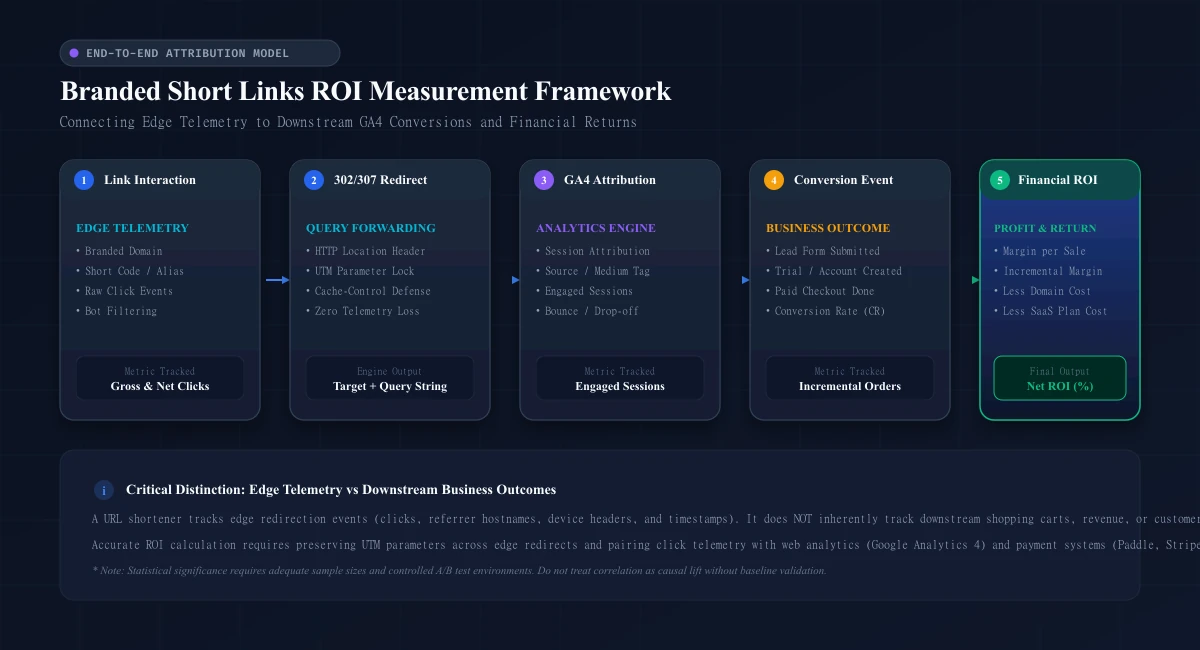
Calculating credible link ROI requires tracking metrics across each step of the user journey. Marketers must distinguish between top-of-funnel edge interactions and downstream transactional outcomes.
┌─────────────────┐      ┌─────────────────┐      ┌─────────────────┐      ┌─────────────────┐
│   Edge Clicks   │ ──►  │  GA4 Sessions   │ ──►  │ Key Conversions │ ──►  │ Financial Return│
│ (Link Platform) │      │  (Analytics)    │      │  (CRM / App)    │      │ (ERP / Stripe)  │
└─────────────────┘      └─────────────────┘      └─────────────────┘      └─────────────────┘
1. Link Impressions
The number of times a link was displayed to prospective visitors (e.g., email opens, social media post views, ad impressions, or direct mail recipients). Impressions establish the baseline denominator for calculating click-through rate (CTR).
2. Edge Clicks (Gross vs. Net)
The number of times the link management server executed an HTTP redirect.
- Gross Clicks: Total redirection requests received by edge proxies.
- Net Clicks: Redirection requests filtered to remove automated preview bots (Slackbot, Twitterbot, WhatsApp scrapers) and rapid double-clicks from the same user agent.
3. Analytics Sessions & Engaged Sessions
Recorded by Google Analytics 4 after the visitor's browser executes client-side tracking scripts.
Why Edge Clicks Differ from GA4 Sessions: It is completely normal for edge click counts to exceed GA4 session counts by 5% to 20%. Discrepancies occur when users close the tab before the destination page loads, operate aggressive ad-blockers, reject cookie consent banners, or experience mobile cellular dropouts midway through the redirect cycle.
4. Key Events / Conversions
The specific high-value business actions taken on your website (e.g., demo requests, free trial signups, whitepaper downloads, or completed ecommerce checkouts).
5. Contribution Profit
Net revenue generated from attributed conversions minus variable costs (cost of goods sold, merchant transaction fees, and shipping expenses).
How to Use UTM Parameters and GA4
A common operational flaw in link marketing is assuming that a URL shortener alone can prove business ROI. A link shortener tracks edge clicks; it cannot see what a visitor does after arriving on your website.
To bridge the gap between edge redirects and financial conversions, you must pair your branded short links with standardized UTM parameters.
The Anatomy of an Attributed Short Link
https://go.brand.com/scale-guide
               │
               ▼ (HTTP 302 Edge Redirect Preserves Query String)
https://example.com/scale?utm_source=linkedin&utm_medium=social&utm_campaign=q4_launch&utm_content=branded_link
When structuring tracking campaigns:
- Build your fully qualified destination URL using our free UTM Builder.
- Follow strict taxonomy rules (all lowercase, no spaces, standardized medium tags) as detailed in our comprehensive UTM tagging best practices guide for GA4.
- Paste the tagged URL into your link management system to generate the branded short link.
Redirect Query-String Preservation
Ensure your link platform supports clean query-string preservation. In URLShortPilot, when a short link receives incoming traffic, the edge redirect engine dispatches an HTTP 302 or 307 response that preserves all destination query parameters without stripping or re-encoding tags.
For an in-depth breakdown of how HTTP status codes affect browser caching and analytics logging, read our guide on 301 vs 302 redirects and SEO impact.
How to Run a Fair Branded vs Generic Link Test
You cannot simply claim that branded links increased your revenue if you also changed your email copywriting, ran ads to a new audience, or launched a holiday discount at the same time. To determine true incremental value, growth teams must run controlled experiments.
Guidelines for a Scientifically Sound Test:
- Isolate the Variable:
Keep the message copy, imagery, timing, audience segment, and destination landing page 100% identical. The only difference between Variant A and Variant B must be the link domain (e.g., bit.ly/xyz vs. links.brand.com/xyz).
- Ensure Randomized Audience Splitting:
Use an email marketing platform or ad server that supports true randomized split testing (A/B testing). For example, distribute Variant A to 50% of your email list and Variant B to the remaining 50% simultaneously.
- Verify Sample Size and Statistical Significance:
Avoid drawing conclusions from small sample sizes. If Variant A receives 12 clicks and Variant B receives 15 clicks, the difference is statistically indistinguishable from random noise. Use online sample size calculators to ensure your experiment achieves at least 95% statistical confidence before declaring a winner.
- Track Downstream Conversions, Not Just Clicks:
In some campaigns, generic links may attract curious but low-intent clicks, while branded links attract fewer but higher-converting buyers. Always calculate ROI based on final conversions and contribution profit.
How to Estimate the Cost of a Custom Short Domain
Before launching a branded link initiative, document all associated financial and operational expenses to establish an accurate baseline for your ROI denominator ($\Delta C$):
┌────────────────────────────────────────────────────────────────────────┐
│ Total Branded Link Operating Cost Breakdown                            │
├────────────────────────────────────────────────────────────────────────┤
│ 1. Domain Registration: $10 – $50 / year (e.g. .com, .co, .link)       │
│ 2. SaaS Link Platform:  $0 – $300 / year (e.g. URLShortPilot Pro plan)  │
│ 3. Engineering Setup:   0.5 – 1.0 hour one-time DNS CNAME setup         │
│ 4. Ongoing Governance:  0.25 hour / month link auditing & monitoring   │
└────────────────────────────────────────────────────────────────────────┘
Because total annual operating costs typically range between $150 and $400 per year for small-to-midsize businesses, the threshold for achieving a positive ROI is remarkably attainable.
For example, if your business sells a B2B SaaS subscription with a contribution margin of $100 per customer, generating just 3 to 4 incremental customer purchases per year covers the entire annual operating cost of your custom short domain.
Branded Link Use Cases by Marketing Channel
Different marketing channels present unique cost and conversion economics. Here is how branded short links deliver commercial value across six core distribution channels:
1. SMS and Mobile Messaging Campaigns
SMS messages are billed in strict 160-character segments. Long destination URLs with attached UTM parameters routinely exceed 150 characters on their own, pushing a single text message into two or three billing segments.
Using a concise branded link (e.g., brand.co/deal) keeps tracking URLs under 18 characters, preventing multi-segment billing overages while displaying trusted branding directly within mobile messaging feeds.
2. Social Media Profiles and Organic Bio Links
On visual and micro-blogging platforms (Instagram, TikTok, Twitter/X), character caps and aesthetic standards make long URLs unviable. A clean branded link reinforces brand identity and signals professionalism to followers and prospective sponsors.
3. QR Codes for Packaging and In-Person Events
Encoding a 200-character raw tracking link into a QR code creates a dense, complex matrix that frequently fails to scan under poor lighting or on curved packaging surfaces.
By shortening the destination URL with a branded short link first, you reduce the QR matrix density down to Version 2 or 3, drastically improving scanning speeds across diverse smartphone cameras. Discover how to create print-ready graphics using our free QR Code Generator.
4. Direct Mail, Print Catalogs, and Offline Collateral
When consumers encounter web addresses on printed postcards, magazine advertisements, or product retail boxes, they must type the address manually into their mobile browser. Nobody will type https://company.com/products/category?utmsource=print&utmmedium=flyer. A concise branded URL like brand.link/save20 is simple to remember and type error-free.
5. Affiliate and Influencer Partnerships
Providing external affiliates and social media creators with transparent, branded tracking links (brand.co/creator-name) builds partner pride and reassures their audiences that the recommendation is officially endorsed by your company.
6. Transactional Customer Communications
Password reset notifications, shipping confirmation alerts, and appointment reminders sent via SMS or WhatsApp benefit tremendously from branded domains. Users are trained never to click unfamiliar links in transactional messages; displaying your verified domain ensures message legitimacy.
Common ROI Measurement Mistakes
Avoid these five frequent analytical pitfalls when evaluating your link marketing investments:
1. Confusing Gross Revenue with Contribution Profit
If your branded link campaign generates $5,000 in gross sales, but fulfilling those orders costs $4,800 in inventory and shipping, your incremental value is $200, not $5,000. Calculating ROI using top-line revenue artificially inflates results and masks unprofitable marketing programs.
2. Expecting Link Shorteners to Act as Full-Funnel Attribution Platforms
A URL shortener is an edge redirection engine, not a replacement for a multi-touch attribution platform or customer data platform (CDP). Always route tracking parameters into web analytics platforms like GA4 and payment engines to measure full customer journeys.
3. Overlooking Preview Scrapers and Automated Bot Traffic
Chat platforms (Slack, Teams, iMessage, Discord) and anti-virus scanners crawl hyperlinks automatically to render OpenGraph social cards or inspect destination safety. Ensure your metrics rely on human sessions recorded in GA4 rather than raw server hit counters.
4. Ignoring Ongoing Renewal and Governance Costs
Remember to include annual domain renewal fees and ongoing SaaS platform subscriptions in your cost baseline. While modest, failing to account for recurring overhead undermines financial modeling accuracy.
5. Assuming Branded Links Solve Weak Product-Market Fit
A branded short domain improves trust, memorability, and click-through rates at the margin. However, it cannot compensate for uncompelling copywriting, poor landing page design, slow site speeds, or an uncompetitive product offer.
How to Start Using Branded Links with URLShortPilot
Deploying custom short domains with URLShortPilot takes only a few minutes and requires zero complex server maintenance:
- Acquire a Dedicated Subdomain or Vanity Domain:
Select a concise subdomain (e.g., links.yourcompany.com) or a dedicated short domain (e.g., comp.link).
- Add Your Domain in the Dashboard:
Navigate to the Custom Short URLs dashboard and input your hostname.
- Configure DNS Records:
In your domain registrar (Cloudflare, Namecheap, GoDaddy, AWS Route 53), add a CNAME record pointing to cname.urlshortpilot.com along with a one-time TXT verification token.
- Automatic SSL/TLS Provisioning:
URLShortPilot automatically provisions and renews free edge SSL certificates for all connected domains.
- Shorten and Distribute:
Create branded links with custom back-half slugs using our URL shortener, attach standardized tracking parameters with our UTM Builder, and monitor real-time click volume directly from your analytics console.
Frequently Asked Questions (FAQ)
Do branded short links improve SEO rankings directly?
No. Search engine crawlers (such as Googlebot) treat 301 and 302 redirects similarly regardless of whether they originate from a generic shortener or a branded domain. Branded links do not directly transfer ranking signals to your primary corporate domain. However, branded links improve click-through rates and brand exposure across external channels, indirectly driving more referral traffic and organic brand search queries.
What is the typical click-through rate lift from using branded links?
Controlled marketing studies typically report click-through rate increases ranging from 10% to 35% when switching from opaque generic links to recognizable branded URLs. However, results vary based on industry trust baselines, channel context, and audience familiarity with your brand.
Can I track conversions directly inside URLShortPilot?
URLShortPilot records edge click events, referring hostnames, device classifications, and geographic distribution using privacy-safe hashed IPs. To measure downstream conversions, ecommerce checkouts, or lead generation forms, pair URLShortPilot with standardized UTM tags and evaluate goal completions inside Google Analytics 4.
What happens if my custom domain expires?
If your custom short domain registration lapses with your domain registrar, DNS resolution fails and your short links will stop redirecting visitors. We strongly recommend configuring auto-renewal with your domain registrar to ensure uninterrupted link redirection.
Final Checklist and Conclusion
Measuring the ROI of branded short links requires moving beyond vanity metrics and applying disciplined unit economics. When implemented thoughtfully, custom short domains provide an affordable, high-leverage mechanism to enhance audience trust, preserve marketing attribution, and boost campaign profitability.
Pre-Deployment ROI Checklist:
- [ ] Document Baseline Costs: Record annual domain registration fees and link platform subscription costs.
- [ ] Establish Control Benchmarks: Document historical CTR and conversion rates using generic links.
- [ ] Standardize UTM Taxonomy: Enforce consistent naming conventions across all campaigns.
- [ ] Verify Query Preservation: Test redirects to ensure tracking parameters reach destination pages intact.
- [ ] Configure GA4 Conversion Events: Confirm key transactional milestones are actively recorded in analytics.
- [ ] Calculate Incremental Contribution Profit: Base ROI calculations strictly on net profit, not gross revenue.
Ready to upgrade your link management infrastructure? Explore URLShortPilot Custom Short URLs to connect your branded domains and deploy fast, trackable short links today.
Ready to streamline your links?
Create fast, secure short links with real-time analytics, custom domains, and enterprise-grade anti-abuse protections.
Related Technical Guides
How to Set Up a Custom Short Domain: Complete Guide
A complete technical guide to setting up a custom short domain for branded links: CNAME and TXT DNS records, domain ownership verification, automated SSL/TLS certificates, and troubleshooting.
301 vs 302 Redirects: Differences, SEO Impact & Best Practices
Learn the differences between 301 and 302 redirects: SEO impact, link equity, browser caching, 307 vs 308, and why URL shorteners use temporary redirects.
UTM Tagging Best Practices: How to Track Campaigns in Google Analytics 4
Master UTM tagging best practices for GA4. Learn parameter syntax, naming conventions, channel groupings, redirect preservation, and troubleshooting.