How Do URL Shorteners Work? A Complete Technical Guide
An in-depth technical guide to URL shortener architecture: unbiased Base62 token generation, in-memory caching tiers, RFC 9110 HTTP 301 vs. 302/307 redirect mechanics, and decoupled analytics pipelines.
How Do URL Shorteners Work? A Complete Technical Guide
Every day, billions of internet users click compact web links across social media feeds, SMS notifications, physical QR codes, and corporate emails. A lengthy web address containing tracking parameters and deeply nested directory paths—such as https://example.com/products/electronics/audio/wireless-headphones?utmsource=newsletter&utmmedium=email&utmcampaign=summersale_2026—is transformed into a concise address like https://urlshortpilot.com/audio26.
Yet despite their ubiquity, few web users and developers fully understand the technical machinery operating behind that single click.
A URL shortener is far more than a simple text replacer. At scale, a modern link platform operates as a distributed routing engine designed to resolve requests with minimal server overhead, filter automated crawlers, protect users from malicious exploits, and record granular click telemetry without delaying the visitor's browsing experience.
In this technical guide, we will unpack how URL shorteners work under the hood: from the mechanics of HTTP status codes and the mathematics of Base62 token generation to in-memory caching tiers, asynchronous telemetry pipelines, and link security defenses.
What Is a URL Shortener? (The Direct Definition)
A URL shortener is an internet routing service that maps a compact alphanumeric key (called a slug or short code) to a target destination URL stored in a database. When a visitor or client requests the short URL, the shortener's web server intercepts the incoming request, locates the matching destination URL in its index or cache, and immediately issues an HTTP redirect response instructing the client's browser to navigate to the original web address.
The core utility of URL shortening provides two distinct functions:
- Human Usability & Visual Economy: Compact links fit within strict character limits (such as SMS or social media bios), look clean in print materials, and can be rendered into low-density, easily scannable QR codes.
- Attribution & Telemetry: Because the shortener intercepts the initial navigation request, it acts as a telemetry gateway—measuring click volume, geographic regions, referring channels, and device types before transferring the user to the destination server.
Step-by-Step: What Happens When You Click a Short URL?
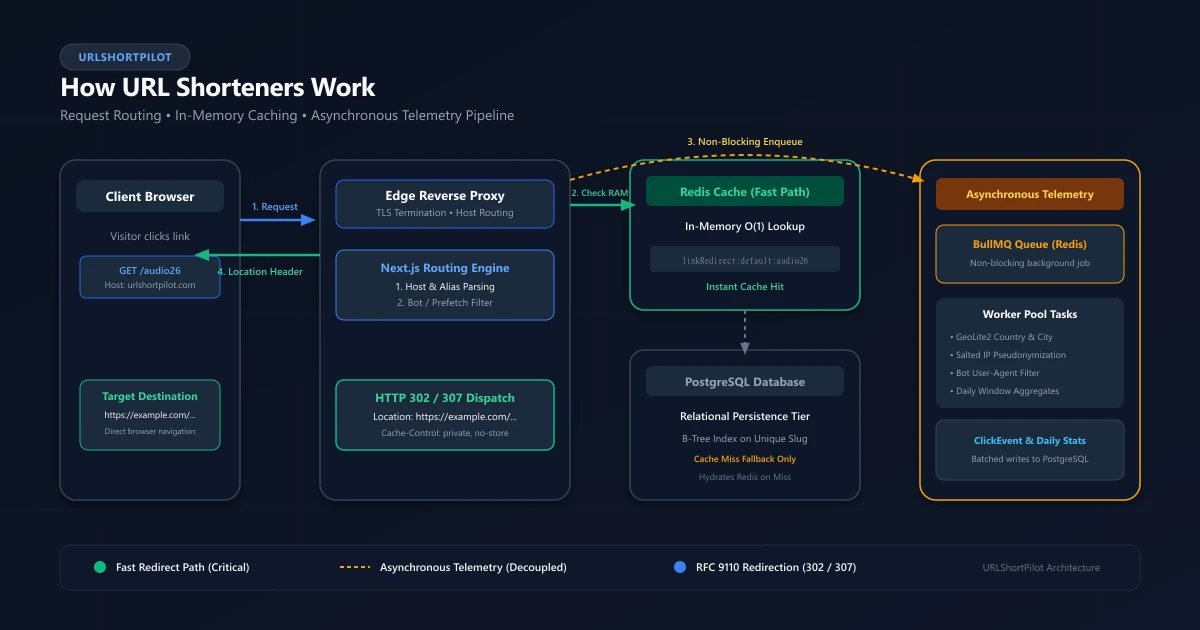
When a visitor clicks a shortened link, a multi-stage request-response cycle takes place across the network. To the user, the redirection feels seamless. The total perceived duration is determined primarily by the client-to-server network round-trip time (RTT), DNS resolution, TLS session negotiation, and edge server processing.
Here is the step-by-step sequence of that interaction:
- DNS Resolution: The client browser queries Domain Name System (DNS) servers to resolve the domain of the short URL (for example,
urlshortpilot.comor a custom branded domain likelinks.yourbrand.com) to the edge server's IP address. - TCP Connection & TLS Handshake: The browser establishes a secure connection with the shortener's reverse proxy (such as Caddy or Nginx) over HTTPS (port 443).
- HTTP GET Request: The browser transmits an HTTP request for the path containing the unique short code:
GET /audio26 HTTP/1.1
   Host: urlshortpilot.com
   User-Agent: Mozilla/5.0 (Macintosh; Intel Mac OS X 10_15_7) ...
Accept: text/html,application/xhtml+xml,...- Token Extraction & Cache Lookup: The routing engine isolates the path segment (
audio26) and checks an in-memory caching tier (such as Redis) using an O(1) hash table lookup. - Database Fallback (on Cache Miss): If the key is not present in memory, the application queries its primary relational database (such as PostgreSQL), locates the matching destination, and populates the cache with an eviction policy.
- HTTP Redirect Response Dispatched: The server responds to the browser with an HTTP redirect status code (typically
302 Foundor307 Temporary Redirect) and provides the destination web address in theLocationheader, along with strict cache-control directives:
HTTP/1.1 302 Found
   Location: https://example.com/products/electronics/audio/wireless-headphones?...
   Cache-Control: private, no-cache, no-store, must-revalidate
   Pragma: no-cache
   Expires: 0
Content-Length: 0- Asynchronous Telemetry Ingestion: During request completion, the application enqueues raw click metadata (timestamp, client IP, user agent, referrer) to a background message queue so subsequent analytics processing does not delay the user's redirect.
- Browser Navigation: The client browser reads the
Locationheader and automatically initiates a second HTTP request directly to the destination website.
Request Architecture: Fast Path vs. Analytics Pipeline
The following architectural diagram illustrates how a production URL shortening engine handles edge lookups, database fallbacks, and decoupled analytics processing:
[ User Browser ]
       │
       │ 1. GET /audio26
       ▼
┌────────────────────────────────────────────────────────┐
│  Edge Reverse Proxy (TLS Termination & Routing)        │
└──────────────────────────┬─────────────────────────────┘
                           │
                           │ 2. Forward Request
                           ▼
┌────────────────────────────────────────────────────────┐
│  URL Shortener Routing Engine (Application Service)    │
└──────────────┬───────────────────────────┬─────────────┘
               │                           │
    3. Query Key (O(1) RAM)       7. Enqueue Telemetry (Async)
               ▼                           ▼
┌──────────────────────────────┐ ┌──────────────────────────────┐
│  In-Memory Cache (Redis)     │ │  Background Queue (BullMQ)   │
└──────────────┬───────────────┘ └──────────────┬───────────────┘
               │                                │
        Cache Miss Fallback              Worker Processing
               ▼                                ▼
┌──────────────────────────────┐ ┌──────────────────────────────┐
│  Relational DB (PostgreSQL)  │ │  Analytics Storage / Rollups │
└──────────────────────────────┘ └──────────────────────────────┘
               │
               │ 4. Return Target URL
               ▼
┌────────────────────────────────────────────────────────┐
│  HTTP Redirect Response (302/307 + Location Header)    │
└──────────────────────────┬─────────────────────────────┘
                           │
                           │ 5. Direct Navigation
                           ▼
[ Target Website (https://example.com/headphones) ]
How HTTP Redirects Work: 301 vs. 302 vs. 307 vs. 308
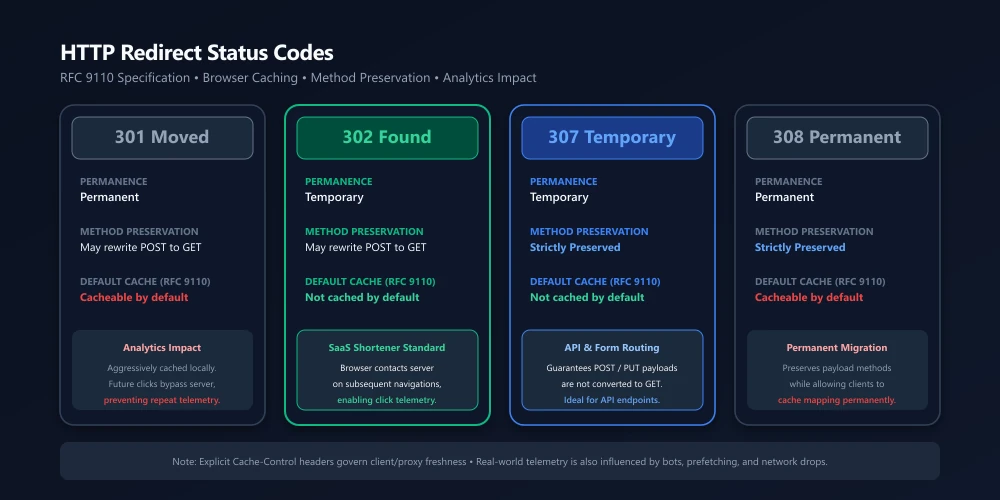
At the core of every URL shortener is HTTP redirection, standardized under RFC 9110. However, redirect status codes behave differently regarding caching semantics and request method preservation. Choosing the appropriate code directly influences browser behavior, search engine indexing, and analytics accuracy.
| HTTP Status Code | Formal RFC Name | Default Cache Behavior (RFC 9110) | Method Preservation | Impact on URL Shortener Operations |
|---|---|---|---|---|
| 301 | Moved Permanently | Cacheable by default | May change POST to GET | Browsers cache the destination locally. Subsequent clicks bypass the shortener server entirely, which breaks repeat click tracking. |
| 302 | Found (Temporary) | Not cacheable by default | May change POST to GET | Browsers re-request the shortener on subsequent visits, allowing telemetry logging while redirecting standard web traffic. |
| 307 | Temporary Redirect | Not cacheable by default | Strictly preserves HTTP method | Guarantees that request payloads (POST, PUT) are not altered to GET. Ideal for API routing and temporary web links. |
| 308 | Permanent Redirect | Cacheable by default | Strictly preserves HTTP method | Combines permanent browser caching with strict method preservation. Subsequent clicks bypass the shortener. |
Why URL Shorteners Favor HTTP 302 and 307
If a URL shortener issues a permanent 301 Moved Permanently response without restrictive cache headers, compliant client browsers store the mapping in their local disk cache. The next time that same user clicks the link, the browser resolves the target locally without making a network request to the shortener.
While this saves server resources, it prevents click tracking: subsequent clicks from that user are invisible to the platform.
To balance user experience with reliable attribution, production link platforms primarily use HTTP 302 Found or HTTP 307 Temporary Redirect. By pairing temporary status codes with explicit HTTP cache-control headers (Cache-Control: private, no-cache, no-store, must-revalidate), the shortener requests that intermediate proxy caches and client browsers re-validate or re-fetch the short link upon each click.
If you are debugging redirect behavior or troubleshooting redirect hops across an existing link, you can inspect each status code hop using an online redirect checker.
Why Click Tracking Can Never Be 100% Guaranteed
While temporary redirects prompt conforming browsers to contact the shortener on repeat visits, no web telemetry system can achieve 100% measurement accuracy in the real world. Several practical boundaries introduce variance:
- Automated Link Previews & Bots: Modern chat applications (such as Slack, Discord, iMessage, and WhatsApp) automatically fetch URLs when pasted into conversations to render OpenGraph preview cards. While link platforms maintain bot detection heuristics, some crawlers mimic standard mobile browsers.
- Speculative Browser Prefetching: Browsers like Google Chrome and Apple Safari often pre-fetch links speculatively based on user mouse movements or search results. URLShortPilot mitigates this by inspecting edge headers (such as
purpose: prefetchandsec-purpose) and returning an HTTP 204 No Content without logging a click, but not all client software sends standardized fetch metadata. - Ad-Blockers & Tracking Protections: Privacy tools and browser privacy features (such as Firefox Enhanced Tracking Protection or Safari Private Browsing) may strip campaign parameters or block redirect domains flagged on community lists.
- Network Interruptions: If a user closes their browser tab or loses cellular connectivity midway through a TLS handshake, the network request may partially execute or terminate before the redirect cycle completes.
How Short Link Tokens Are Generated: The Mathematics of Base62
When you submit a destination web address into a URL shortener, the application must generate a unique, compact identifier (slug) representing that record.
How does a platform ensure that millions—or even billions—of links receive short, collision-resistant keys without exposing sensitive internal data?
Why Auto-Incrementing Numbers Fail in Production
A naive approach is to use database auto-incrementing integer IDs:
- First link:
domain.com/1 - Second link:
domain.com/2 - One-thousandth link:
domain.com/1000
While simple to implement, sequential numbering introduces critical security and business vulnerabilities:
- Enumeration & Scraping Attacks: Anyone can write a basic script to query
domain.com/1,domain.com/2,domain.com/3sequentially, discovering private, unlisted, or staging links created by other users. - Business Intelligence Leakage: Competitors can create two links 24 hours apart, compare the sequential IDs, and accurately deduce your company's daily link creation volume.
Anatomy of a Short Link: Custom Alias vs. Random Token
Before looking at random generation, it is helpful to visualize how a modern short URL is structured:
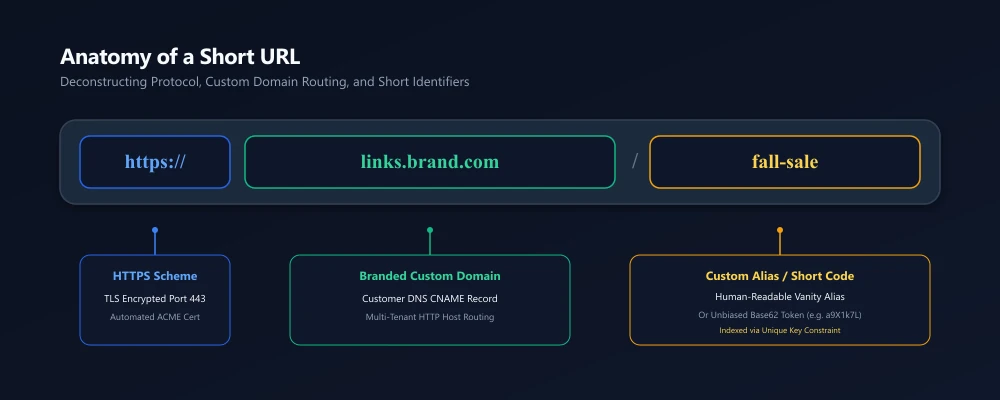
A shortened link consists of three distinct components:
- The Transport Scheme (
https://): Enforces encrypted TLS communication over port 443. - The Domain (
links.brand.com): Directs DNS resolution to the shortener's edge proxy, either using the platform's default domain or a customer's branded CNAME domain. - The Path Segment (
/fall-sale): Identifies the target record in the database. This can be a human-readable vanity alias chosen by the user, or a non-sequential, randomly generated Base62 key.
Base62 Character Encoding
To prevent sequential enumeration, modern systems use Base62 character encoding.
Base62 uses 62 alphanumeric characters:
- 10 numeric digits:
0–9 - 26 lowercase letters:
a–z - 26 uppercase letters:
A–Z
Because Base62 is case-sensitive and omits punctuation (avoiding URL-unsafe characters like ?, &, =, or /), it packs significant mathematical entropy into very few characters.
The total theoretical combinations (keyspace capacity) for a token of length L is calculated as:
Keyspace = 62^L
| Token Length | Total Theoretical Combinations | Example Token |
|---|---|---|
| 4 Characters | 62⁴ = 14,776,336 (~14.7 Million) | a9X1 |
| 5 Characters | 62⁵ = 916,132,832 (~916 Million) | bK8m2 |
| 6 Characters | 62⁶ = 56,800,235,584 (~56.8 Billion) | x7Pq9A |
| 7 Characters | 62⁷ = 3,521,614,606,208 (~3.52 Trillion) | R9mK3xL |
| 8 Characters | 62⁸ = 218,340,105,584,896 (~218 Trillion) | Z2w9Lp4Q |
Keyspace Capacity vs. The Birthday Paradox
A common misconception is that a 7-character keyspace of 3.52 trillion combinations allows a platform to generate 3.52 trillion random links without ever encountering a collision.
This confuses total keyspace capacity with random collision probability. When keys are chosen at random rather than assigned deterministically in sequence, the Birthday Problem governs collision rates. In any random key space of size N, the probability of encountering at least one collision reaches approximately 50% after generating:
k ≈ √(2N · ln(2)) ≈ 1.177 × √N
For a 7-character Base62 keyspace:
k ≈ 1.177 × √(3.52 × 10¹²) ≈ 2.21 × 10⁶
This means that after generating approximately 2.2 million random tokens, there is already a 50% statistical chance of at least one collision occurring. Even after generating just 85,000 links, the probability of a collision exceeds 0.1%.
Consequently, production URL shorteners cannot rely on random generation alone. They must implement two safeguards:
- Database Uniqueness Constraints: A
UNIQUEindex constraint on the slug column to guarantee transactional data integrity at the database layer. - Application Retry Loops: An automated retry mechanism that generates an alternative token if a collision is detected, expanding the token length if retries are exhausted.
Cryptographic Generation & Modulo Bias
When generating random tokens from raw bytes, developers must be careful to avoid modulo bias.
A common but flawed implementation maps random bytes directly using the modulo operator:
// Flawed approach: suffers from modulo bias
result += BASE62_CHARSET[bytes[i] % 62];
Because a single byte holds 256 distinct values (0 to 255), and 256 is not evenly divisible by 62:
256 = (4 × 62) + 8
Values between 0 and 7 appear 5 times in the range 0 to 255, while values between 8 and 61 appear only 4 times. Characters at indices 0 through 7 have a 5/256 (~1.95%) probability of selection, whereas characters at indices 8 through 61 have only a 4/256 (~1.56%) probability. This introduces an uneven distribution that skews token randomness.
To achieve a uniform, unbiased distribution, production generators use rejection sampling (discarding byte values greater than or equal to 248) or Node.js's built-in crypto.randomInt(0, 62).
In URLShortPilot, uniform token generation is implemented in src/lib/utils/short-code.ts using rejection sampling over cryptographically secure random bytes:
import crypto from "crypto";

const BASE62_CHARSET = "0123456789abcdefghijklmnopqrstuvwxyzABCDEFGHIJKLMNOPQRSTUVWXYZ";
const ALPHABET_LEN = BASE62_CHARSET.length; // 62
const MAX_UNBIASED_BYTE = 248; // Largest multiple of 62 within uint8 (4 * 62)

/**
 * Generates an unbiased, cryptographically secure Base62 short token.
 * Uses rejection sampling to eliminate modulo bias.
 */
export function generateShortToken(length = 7): string {
  let result = "";

  while (result.length < length) {
    const needed = length - result.length;
    const batchSize = Math.max(needed, Math.ceil((needed * 256) / MAX_UNBIASED_BYTE));
    const bytes = crypto.randomBytes(batchSize);

    for (let i = 0; i < bytes.length && result.length < length; i++) {
      const byte = bytes[i];
      // Discard values >= 248 to guarantee an exact uniform 1/62 probability
      if (byte < MAX_UNBIASED_BYTE) {
        result += BASE62_CHARSET[byte % ALPHABET_LEN];
      }
    }
  }

  return result;
}
Database Storage & Multi-Tenant Lookup Architecture
A production URL shortener relies on a normalized relational database schema paired with an in-memory caching tier to separate read traffic from relational transaction processing.
Relational Schema Design
In a multi-tenant relational system (such as PostgreSQL managed with Prisma), the schema must handle custom branded domains, user ownership, expiration rules, and unique short codes.
┌────────────────────────────────────────────────────────┐
│  CustomDomain Model                                    │
├────────────────────────────────────────────────────────┤
│  id: String (PK)                                       │
│  domain: String (Unique, e.g. "links.brand.com")       │
│  status: DomainStatus (PENDING | ACTIVE | FAILED)      │
│  sslStatus: SslStatus (PENDING | READY | ERROR)        │
└──────────────────────────┬─────────────────────────────┘
                           │ 1-to-Many
                           ▼
┌────────────────────────────────────────────────────────┐
│  Link Model                                            │
├────────────────────────────────────────────────────────┤
│  id: String (PK)                                       │
│  domainId: String? (FK -> CustomDomain.id)             │
│  shortCode: String (Unique)                            │
│  customAlias: String? (Unique)                         │
│  originalUrl: Text                                     │
│  redirectType: RedirectType (301 | 302 | 307 | 308)    │
│  status: LinkStatus (ACTIVE | DISABLED | EXPIRED)      │
│  expiresAt: DateTime?                                  │
│  maxClicks: Int?                                       │
│  clickCount: Int (Default 0)                           │
└────────────────────────────────────────────────────────┘
When a request arrives at the edge:
- The routing engine reads the HTTP
Hostheader (e.g.,links.brand.com). - If the request uses a custom branded domain, the platform resolves the domain record to obtain its
domainId. - The application queries the repository for the matching
shortCodeorcustomAliasscoped to that domain context.
Two-Tier Storage: Relational Durability + Redis Caching
While PostgreSQL B-Tree indexes resolve queries efficiently, routing high-concurrency click traffic directly through relational databases creates connection pool contention and disk I/O load.
To protect relational databases, link platforms deploy an in-memory Redis caching tier:
- Host-Aware Cache Keys: Short link metadata is cached in Redis using host-scoped keys:
- Default domain key:
linkRedirect:default:audio26 - Branded domain key:
linkRedirect:links.brand.com:audio26
- In-Memory Speed: Because Redis operates directly in RAM, cache hits execute with O(1) hash table lookup efficiency, bypassing disk operations and database query parsers.
- Pre-Warming & Eviction: Production platforms pre-warm the Redis cache immediately upon link creation. If an author updates the destination URL, adds an expiration timestamp, or archives a link in their dashboard, the application immediately purges or updates the corresponding Redis key to prevent stale redirections.
Decoupled Click Telemetry: Non-Blocking Analytics
One of the key engineering challenges in URL shortener architecture is capturing rich analytics without adding latency to the visitor's redirect.
Marketers rely on detailed campaign telemetry:
- Timestamp of the interaction
- Referring URL (e.g. social platforms, search engines, newsletter webmail)
- Geographic location (Country, Region, City)
- Device and operating system (Mobile vs. Desktop, iOS vs. Android)
- UTM campaign tags appended to the target URL
The Latency Problem of Synchronous Writes
If a web server wrote analytics events synchronously to the primary database before dispatching the redirect header, the visitor's browser would be forced to wait:
Total Redirect Latency = DB Lookup Time + GeoIP Resolution + Telemetry DB Write + Network RTT
Under high traffic spikes, database write locks and network overhead can delay the redirect, increasing bounce rates and degrading user experience.
The Solution: Asynchronous BullMQ Processing
Modern architectures decouple telemetry from the redirect cycle using message queues like BullMQ running on Redis:
[ Inbound Request ] ──► [ Redis Cache Hit ] ──► [ HTTP 302 Dispatched to User ]
                                                       │
                                                       ▼ (Non-Blocking Enqueue)
                                            [ BullMQ / Redis Queue ]
                                                       │
                                                       ▼ (Worker Pool)
                                            [ GeoLite2 IP Lookup ]
                                            [ Salted IP Hashing ]
                                            [ Bot Classification ]
                                                       │
                                                       ▼ (Batched Storage)
                                            [ PostgreSQL ClickEvent ]
[ Daily Aggregated Stats ]- The redirect handler returns the HTTP response back to the browser immediately.
- Concurrently, a lightweight telemetry payload is pushed to an in-memory queue. While enqueuing a job is not literally instantaneous—it involves minor in-process serialization and an in-memory Redis write—it avoids waiting for heavy disk I/O or multi-table aggregations.
- Background worker processes consume the queue asynchronously:
- Resolving geographic coordinates using an offline local database (such as MaxMind GeoLite2).
- Parsing user-agent strings to classify devices and identify automated bots.
- Performing salted IP hashing to avoid storing plaintext IP addresses.
- Persisting raw click records and incrementing daily rollup statistics in bulk transactions.
Data Privacy & GDPR: Understanding Salted IP Hashes
To minimize privacy risks, responsible platforms avoid storing raw, plaintext IP addresses in persistent database tables. Instead, incoming IP addresses are hashed using HMAC-SHA256 combined with a secret server salt.
However, from a regulatory standpoint under the European Union General Data Protection Regulation (GDPR) and official European Data Protection Board (EDPB) guidance, salted IP hashes are classified as pseudonymized data, not fully anonymized data.
Because the IPv4 address space contains approximately 4.29 billion possible addresses, an attacker who gains access to a compromised salt could pre-compute lookup tables (rainbow tables) to reverse hashes back to individual IP addresses.
Therefore, while salted hashing provides essential defense-in-depth and data minimization, modern architectures combine it with rolling daily windows (such as URLShortPilot's generateVisitorHash) to estimate unique visitors over 24-hour periods without creating longitudinal user tracking profiles across the web.
Branded Custom Domains, Vanity Aliases & QR Codes
While generic short URLs are useful for basic character reduction, enterprise marketing and product teams rely on branded links and physical touchpoints.
1. Branded Custom Domains
Instead of sharing a generic short domain, organizations connect their own domain (such as links.yourcompany.com).
- DNS Setup: The domain owner creates a DNS
CNAMErecord pointing their subdomain to the URL shortener's edge infrastructure. - Automated TLS (SSL): Edge proxies (such as Caddy) automatically negotiate TLS certificates with Let's Encrypt or ZeroSSL using the ACME protocol, ensuring all short links are encrypted over HTTPS.
- Host-Based Routing: When incoming traffic reaches the edge, the routing engine inspects the HTTP
Hostheader to isolate the user workspace and resolve custom aliases. - Learn More: You can explore the branding and security advantages of vanity links in our guide to custom short URLs.
2. QR Code Integration & Data Density
A QR (Quick Response) code is a two-dimensional barcode standardized under ISO/IEC 18004.
Why should you always pair QR codes with short URLs?
- Matrix Density & Scan Reliability: The visual complexity of a QR code depends on the number of encoded characters and the chosen Reed-Solomon error correction level (L: 7%, M: 15%, Q: 25%, or H: 30%). Long URLs with dozens of campaign tracking parameters require higher QR versions with smaller, tightly packed modules. These dense codes are more vulnerable to scanning errors on smartphone cameras under poor lighting, steep angles, or physical print wear. In contrast, a concise short link produces a low-version QR code with larger, high-contrast modules that scan quickly and reliably across camera hardware.
- Dynamic Destination Updates: If you print a direct URL on physical flyers or product packaging, the destination is permanently locked. By printing a dynamic short link, you can update the destination URL in your dashboard at any time without reprinting physical collateral. You can generate custom vector codes with our free QR code generator.
URL Security, Abuse Prevention & Diagnostic Tools
Because shortened links obscure the destination address, they have historically been targeted by malicious actors for phishing campaigns, spam, and malware distribution.
Production link platforms deploy multi-layered security controls to protect internet users:
1. Real-Time Domain Blocklists
Link services evaluate long URLs against malicious domain blocklists before allowing link creation. If a target domain is flagged for phishing, malware, or spam, the system rejects the submission.
2. Server-Side Request Forgery (SSRF) Protection
When link shorteners validate destination addresses or fetch OpenGraph preview metadata, they must ensure attackers cannot exploit the shortener to probe private internal infrastructure (such as http://169.254.169.254 for cloud metadata or http://localhost:5432 for databases). Production validators enforce strict IP filtering, blocking requests targeting private RFC 1918 subnets, loopbacks, and link-local addresses.
3. Diagnostic Link Inspection Tools
If you encounter a suspicious short URL in an email, text message, or social post, do not click it directly. Instead, use diagnostic inspection tools:
- Unshorten the Link: Submit the address to a secure URL unshortener to reveal the real destination address and evaluate the full redirect path without executing client code.
- Inspect Network Status: Use a diagnostic link checker to examine HTTP response status codes, header configurations, and DNS reachability.
Important Security Boundary: Diagnostic tools inspect HTTP response headers, redirect hops, and network reachability—they do not guarantee that a destination website is safe. Threat actors often employ server-side cloaking, returning clean HTML to automated crawlers while serving phishing or malware payloads to real mobile and desktop browsers. Always exercise caution when visiting unfamiliar web destinations.
Real-World Use Cases for URL Shorteners
URL shortening powers critical digital infrastructure across modern organizations:
- SMS Marketing Campaigns: Standard SMS messages are billed in 160-character segments. Long tracking links exceed segment thresholds, doubling messaging costs. Short links keep messages within a single segment.
- Social Media Profiles & Bio Links: Platforms like X (Twitter) and Instagram impose strict character caps and prioritize clean aesthetics.
- Omnichannel Campaign Attribution: Marketing teams generate distinct tracking links using a UTM builder to trace whether conversions originated from YouTube, LinkedIn ads, or physical brochures.
- Physical Packaging & Print Collateral: Short URLs make manual typing simple for consumers reading printed materials, retail packaging, and conference badges.
- Transactional API Notifications: Modern applications generate programmatic short links via developer APIs to send one-time passcodes, shipment tracking updates, and appointment confirmations.
How to Create a Short Link with URLShortPilot
Creating a trackable short URL on URLShortPilot takes only a few steps:
- Navigate to the free URL shortener tool.
- Paste your long destination address into the input field (ensure it starts with
https://). - (Optional) Add custom UTM campaign parameters or specify a memorable vanity alias (e.g.
summer-promo). - Click Shorten URL.
- Copy your shortened link or download its corresponding dynamic QR code for print.
- Access your dashboard to view real-time click volume, geographic breakdowns, and device analytics.
Frequently Asked Questions (FAQ)
Do URL shorteners hurt SEO rankings?
When configured with permanent redirects (HTTP 301 or 308), search engines generally pass link equity to the destination URL over time and index the target address. Temporary redirects (HTTP 302 or 307) signal to crawlers that the destination is temporary, which typically preserves the short URL's index status unless the redirect remains in place long term. However, for primary internal website navigation, it is best practice to link directly to canonical target URLs rather than through redirect wrappers.
Can a short URL expire?
It depends on the platform configuration. On URLShortPilot, users can configure optional expiration dates (or maximum click thresholds) for time-sensitive promotions. Standard links remain active indefinitely as long as your account is maintained.
What is the difference between a vanity URL and a generic short link?
A generic short link uses the platform's default domain and a random alphanumeric slug (e.g., urlshortpilot.com/x8K2m). A vanity URL uses your company's custom branded domain and a memorable phrase (e.g., links.brand.com/summer-sale), which significantly improves brand trust and click-through rates.
Can I edit the destination of a short link after it is created?
Yes. Because the short URL key points to a database record rather than a static file, you can modify the destination URL in your dashboard at any time. The short link and any printed QR codes will immediately route visitors to the updated destination.
Conclusion & Next Steps
At first glance, a URL shortener appears to be one of the simplest utilities on the web. Yet behind that concise link lies a sophisticated engineering ecosystem: high-entropy Base62 tokenization, in-memory caching tiers, asynchronous analytics queues, and multi-tenant domain routing.
Whether you are optimizing marketing campaign attribution, printing clean QR codes on packaging, or protecting users from malicious link forwarding, modern URL shortening provides the foundational bridge between content creators and their audiences.
Ready to streamline your link management?
Create your trackable short link with URLShortPilot today—and get real-time analytics, custom QR codes, and dependable redirects in a single intuitive platform.
Ready to streamline your links?
Create fast, secure short links with real-time analytics, custom domains, and enterprise-grade anti-abuse protections.